Monday, 19 March, 2012

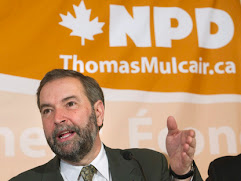
democraticSPACE Supports Thomas Mulcair

Here is the post by democraticSPACE:
[I've added emphasis in bold.]
Seeing the extreme positions taken by Republican candidates in the U.S. gives us a clue as to the typical dynamic of leadership races –- first, having to win over a party’s base who are more dogmatic than the electorate as a whole, then, to appeal to the broader electorate, having to walk back many of those very positions and risk being condemned as a flip-flopper with no principles.
This typical dynamic makes Thomas Mulcair’s strategy for winning the NDP leadership especially interesting. Simply put, he has not followed the script. He has not delivered the boilerplate sound bites that NDP members (consciously or not) have come to expect. Rather than pay respect to where the Party has been, Mulcair has instead outlined where the Party must go (and what must change for the NDP to take the next step, i.e. to form Government). While Mulcair no doubt could have been a bit more “politically correct” in outlining his rationale for departing from the NDP orthodoxy, I give him full credit for not taking the easy path.
The easy thing to do was simply tell traditional NDP constituencies what they wanted to hear, recite the old gospel, and pretend to be as nice as the guy (Jack Layton) whose rather large shoes he is trying to fill. And while his advisors have surely kept reminding him to smile more for the camera, Mulcair is not and will never be Jack Layton. That’s not necessarily a bad thing. Layton resurrected his party from the back corner of the House of Commons to front-and-centre as Her Majesty’s Official Opposition. But it wasn’t because he smiled a lot. It was because he slowly and deliberately shifted the NDP towards a broader appeal. So while Mulcair might strike some hard-line Dippers as “not quite one of us”, his approach is consistent with the trajectory that Layton began.
Now in its government-in-waiting position, the next NDP leader cannot be content merely being the conscience of Parliament. A vote for NDP leader today could well be a vote for the Prime Minister of tomorrow. It cannot be about who smiles the most (or kisses the best!); in fact, it could well be quite the opposite since s/he will be attempting to unseat one of the most strategic and successful Prime Ministers in Canadian history. You don’t have to like Stephen Harper to acknowledge he is determined, disciplined, and yes, successful. And yet, he is not especially popular. Good leaders often aren’t; they don’t merely acquiesce to the most popular idea, they often have a unique capacity to nudge you where you didn’t think you wanted to go.
Each of the other NDP contenders — who are very likable, charismatic and bright — have many strengths essential to an NDP administration, e.g. Nash with labour, Cullen with the West, Ashton with younger voters, Topp strategically, etc. But it seems to me that Mulcair has best demonstrated the qualities of leadership. He has not been afraid to try to convince the base that being in government (i.e. the goal) requires not just opposing what Dippers don’t like (acting on the “no” reflex), but engaging opponents on critical issues and forging *realistic* policies to move these prickly issues towards more just and more sustainable ends. This is especially true on economic issues, which will remain the key battle for the foreseeable future, but which has not traditionally been the NDP’s forte (or at least has not been the issue on which Canadians trust the NDP the most).
That Mulcair arguably has the most direct experience in Government (having served as a Cabinet Minister and been a public servant before that) certainly helps. That he is articulate in both official languages and the only candidate seen as a native son by Quebeckers (who represent 60% of the caucus) also helps. As do his economic (finance critic) and environmental (former Environment Minister) credentials.
But most importantly, he would give the NDP a leader who, though perhaps less politically correct or even as likeable as other candidates, would be as ruthless defending a progressive agenda as Harper defends a conservative agenda. And yet, because he has not taken the easy/conventional path to the NDP leadership, he also seems to be the best placed to make a progressive appeal to voters who have not traditionally supported the NDP. By stepping slightly outside the orthodoxy, Mulcair offers the NDP the best opportunity to form a progressive government. So it seems to me that, on balance, the best choice for NDP leader is Thomas Mulcair.

Thursday, 15 March, 2012

Rob Ford's Pattern of Knowingly Disobeying Conflict of Interest Rules

Ford's pattern of disobeying conflict of interest rules at City Hall goes back to 2005. This list further proves that there is no way Ford can claim ignorance in the new case against him that could get him kicked out of the mayor's position.

See The Toronto Star: Ford's conflicts of interest date back to 2005

Wednesday, 14 March, 2012

List of Toronto G20 Lawuits

The following is a partial list from The Toronto Star: G20 Summit: Cop Unmasked As Protest Couple File Suit
(Read the Star article for all the details)


March 7, 2012: Toronto police settle a human rights claim filed by a paraplegic man arrested during the G20 summit. Terms are not public due to a confidentiality clause.

Feb. 16, 2012: Toronto lawyer Nicholas Wright sues Toronto police for $25,000 for alleged unlawful arrest.

June 24, 2011: Sean Salvati, a paralegal arrested prior to the G20 summit and allegedly strip-searched, assaulted and held naked in a jail cell for nearly an hour sues Toronto police for at least $75,000.

June 23, 2011: Courtney Winkels, threatened with arrest by an officer in a YouTube video for blowing bubbles, sues the Toronto Police Services Board for $100,000 for false arrest and Charter of Rights violations.

March 15, 2011: Two plaintiffs file lawsuits naming the Toronto Police Services Board as defendants and claiming $25,000 in damages. Luke Stewart, a 25-year-old PhD candidate, alleges that during the G20 summit, police said he couldn't enter a park unless he submitted to a search. The other complainant, identified as Kalmplex, is suing police for $25,000 for a wrongful arrest in Parkdale and for extended imprisonment of 20 hours.

May 11, 2011: Charlie Veitch, a British filmmaker arrested under the so-called five-metre law during the G20, sues the province and police for $350,000.
January 2011: Dorian Barton, a 30-year-old cookie maker, files a $250,000 lawsuit against the Toronto Police Services Board and seven unnamed officers, alleging his shoulder was broken and he was denied proper care after his arrest.

Sept. 7, 2010: Natalie Gray of Montreal, who claims she was shot by Toronto police with rubber bullets, files a $1.2 million suit against the Toronto Police Services Board and unnamed individual officers for damages.

Sept. 2, 2010: A $115 million class-action lawsuit involving 1,150 people arrested and detained during the G20 protests in Toronto is filed with the Superior Court. The plaintiffs are represented by lawyer Charles Wagman. The lawsuit has been stayed.

Aug. 6, 2010: A class-action suit is filed by lawyers Eric Gillespie and Murray Klippenstein against the Toronto Police Services Board and the Attorney General of Canada (responsible for the RCMP). The suit, which represents 800 people, seeks $45 million in damages.

Monday, 12 March, 2012

Mayor Ford On Trial. Could Be Removed From Office

Rob Ford is to stand trial for conflict of interest for speaking on and voting on a motion in council that would personally benefit him financially. If the judge is convinced that Ford wilfully broke the rules, then Ford will be removed from office, and the judge would then also decide if he will also be banned from running for public office again (and for how long).

It will be very difficult for Ford to claim that he made a mistake, that he wasn't aware of the rule, because he has been in public office as a councillor for many years, AND he has previously recused himself when he knew there was a conflict of interest.

Clayton Ruby is the lawyer arguing the case against Ford in Superior Court on March 23, 2012.

For more details, see the article in The Toronto Star: Could Mayor Rob Ford Be Removed From Office Over A Conflict Of Interest?
and in the National Post article,
and at the CBC
BlogTO
and a lot of details here at OpenFile
See also:
The Grid: The Case To Remove The Mayor: Another Instance of Anti-Ford Bias?
I am neither a judge nor a lawyer, but the basic, so-far undisputed facts of this case suggest that the mayor had an obvious financial interest, and that he debated and voted on the matter anyway—voting to excuse himself from $3,150 in fines.

It would appear that the only defence that could save Rob Ford from being removed as mayor is that he, after 10 years as a councillor and one year as mayor, did not recognize that he had a financial interest in a vote to save himself $3,150 in penalties. And further, that none of the people he pays to advise him, as the head of Canada’s largest municipality and the CEO of the $9 billion corporation of the city of Toronto, could recognize this interest either.

So the pro-Ford line on this—the balancing piece of information that could save his job as mayor—is that we elected a man too stupid to understand the most obvious element of one of our primary anti-corruption laws and, further, that he staffs his office with people who cannot understand them either.


All Fired Up In the Big Smoke: His Own Worst Enemy
He knowingly flouted the rules. He ignored the council sanctions brought down on him for flouting the rules. He then participated and voted to overturn those sanctions. It is the last thing that has got him into his current troubles. It’s always the last thing that gets you into trouble.

Like I said, I won’t give his rabid supporters the satisfaction of hoping this is a firing offense. But please, stop defending the mayor as some sort of lightning rod for scurrilous attacks, a well-intentioned politician never putting his own career first, and only ever looking out for the little guy. Personal gain isn’t always about money directly into your pocket. For Rob Ford, it was never about the money but about the image. An image he burnished while skirting rules, thumbing his nose at colleagues and the Integrity Commissioner and, once elected mayor, actively participating in avoiding facing the consequences of his actions.

Nobody’s demanding perfection in our politicians but at some point of time there has to be accountability. That time came yesterday for Mayor Rob Ford.
 

Saturday, 10 March, 2012

Crooks & Liars: Harper and his Conservatives and their Election Fraud

We've always known, via an ever-growing mountain of facts, that Harper and his Conservatives are crooks and liars. Will this election fraud situation be the addition to the mountain that will raise it high enough to fall over the wall of denial built by those gullible and ignorant Canadians who continue to vote Conservative against their own best interests?

At the moment, polls show that the Conservative core support still stands behind them. But a smoking gun has not yet been produced. Still waiting on the investigation by Elections Canada.

Friday, 9 March, 2012

Howard Hampton's letter endorsing Thomas Mulcair


The following is an open letter from former Leader of the Ontario New Democratic Party Howard Hampton on behalf of NDP Deputy Leader Thomas Mulcair.

Fellow New Democrats,

As we head into the final weeks of this leadership race, I'm impressed by the positive energy that's building behind Thomas Mulcair.

In just the last two weeks, Tom has not only received the endorsements of fellow leadership candidates Robert Chisholm and Romeo Saganash, but he's also picked up support from the Service Employees International Union (SEIU) led by Sharleen Stewart, the Amalgamated Transit Union (ATU) in Toronto and former NDP Premier of British Columbia Mike Harcourt.

In Quebec, some of the most prominent media sources in the province have come out in support of Tom's campaign.

That's what I call momentum!

Tom's positive message about uniting progressives is clearly capturing the imaginations of New Democrats from coast to coast to coast. It's that kind of hopeful, optimistic leadership that our party needs if we're going to be ready to take on Stephen Harper once this race is over.

That's one of the reasons why I'm so proud to be supporting Thomas Mulcair.

Since the first day of this leadership race, Tom has run a relentlessly positive campaign.

And that's so important. We need to come out of this race united and ready to bring people together to protect our common values.

Consider this:

Just five days after we choose our next leader, our party's caucus will have to stand up in the House of Commons and respond to Stephen Harper's latest Conservative budget.

We'll have to stand up to Mr. Harper's plans to cut healthcare funding and public pensions.

And to do that, we'll have to stand together.

As Tom likes to say, we've had nine great leadership candidates in this race, and in parliament they'll make a great front bench. We should all be thrilled with the calibre of the talent we have in our party.

So let's stay focused on making this a positive race.

Let's stay focused on the message of hope that our party offers to all Canadians.

And, together, let's take the next step.


Howard Hampton
Fmr. Leader of the Ontario New Democratic Party

"Tom Mulcair is the NDPs only alternative"


I've highlighted some key points in the article.


ATHABASCA, AB, Mar. 9, 2012, Troy Media/ – “Ordinary Canadians,” to use a phrase that New Democratic Party leaders have been repeating for decades, are clear about whom they want to win the NDP’s interminable federal leadership race. 

A Forum Research poll, conducted March 2 and 3, asked Canadians which party  they would vote for if a federal election were held that day, providing three different scenarios, namely if Tom Mulcair, Peggy Nash, or Brian Topp, the top three contenders, became NDP leader.


Topp not on top
With Mulcair as leader, the NDP would have received 30 per cent of the vote compared to 32 per cent for the Conservatives, 23 per cent for the Liberals, 8 per cent for the Greens, and 4 per cent for the Bloc Quebecois. But if Nash were leader, the Tories rise to 33 per cent, while the NDP ties with the LIberals at 24 per cent. Put Topp in charge and the Tories go up to 34 per cent, and the Liberals to 25, with the NDP down to 23 per cent.

In terms of seats, a separate Forum poll of 1,675 Quebeckers demonstrates the devastation for the NDP in Quebec if they don’t choose Mulcair.

Mulcair, according to Forum, would garner 40 per cent of the votes in the province for the NDP and, according to the calculations of 308.com, Canada’s main website for mathematically-minded political geeks, that would retain all of the NDP’s current Quebec seats for the party. By contrast, with Topp as leader, the NDP would win only half that percentage of votes and a measly three seats. Worse, Nash as leader would mean a drop to 18 per cent of the Quebec vote and only one seat (presumably Mulcair’s, but if he chose not to run after losing the leadership contest, the evisceration of the NDP in Quebec seems the logical result).

That should clinch it for Mulcair, one would think, and polls published both by the Mulcair electoral team and by the team of leadership candidate Paul Dewar do show the former Quebec Environment Minister and the first NDPer ever to win a federal seat in Quebec in a federal general election in the lead.

But there is much griping within the NDP about Mulcair. The leading candidates generally conceded that he is the only one who is charismatic but many party members fret that, because of that charisma, he will become a one-man show rather than a team player. 

Everyone also concedes his bond with Quebec, but in English Canada, where NDPers have only recently had to come to terms with Quebec demands and Quebec interests, many members seem bound and determined to once again put Quebec in its place even if it costs them all those seats won by Jack Layton and Mulcair in 2011.

Mulcair wants the party to refresh its language, and has gone after such phrases as “ordinary Canadians” and the strategy of targeting unionized workers rather than workers more generally. That has drawn criticism from fellow candidates regarding his commitment to party traditions, even though a key reason for Jack Layton’s breakthrough in 2011 was that he attempted to make the NDP look less scary to people who had not supported the party in the past but who shared at least some of its values.
The fear on the part of many longstanding members is that perhaps Mulcair is not really “one of us.” But what is “one of us?”
Apart from using comfortable clichés that Mulcair, along with B.C.-based candidate Nathan Cullen, have eschewed, the policy differences between the “traditionalists” and Mulcair are minuscule. But a variety of sources are trying to suggest that Mulcair is hiding something from the members. A website called “Know Thomas Mulcair,” which claims to be the voice of unidentified “progressive” party members, but is more likely a front for one of the other candidates’ campaigns, suggests that he is a Zionist tool, and that he was responsible for cutting many jobs when he was a member of Jean Charest’s Cabinet.

The National Post meanwhile suggested that Mulcair had been toying with the idea of joining the federal Conservatives after resigning from Charest’s government. And then there were the revelations that Mulcair gave money to his own constituency association rather than to the national party, something that the federal party expects its elected members to do.

How accurate are these accusations? A comment by Mulcair in 2008 that seemed to suggest that he, like Stephen Harper, was on Israel’s side no matter what has been much quoted. But throughout the campaign, he has, like the other leading candidates, reiterated the party’s official stance that calls for a two-state solution with Canada attempting to play a mediating role rather than the lapdog role for Israel that Harper plays or a parallel role for the Palestinians that some elements of the NDP advocate.

The criticisms of Mulcair’s presence in a Quebec LIberal government that did indeed cut some public service jobs is interesting, considering that no one faults Topp for his behind-the-scenes role in the big cuts that were made by the Romanow NDP government in Saskatchewan. No doubt that is because an NDP government that leans to the right gets a pass that a Liberal government that tacks to the right does not.

Mulcair no “flaming radical”
But, as Mulcair has pointed out, Quebec provincial politics since the 1970s has divided less on right versus left lines than on federalism versus separatism. Within each camp there are rightists, leftists, and centrists, and the overall platforms of both the Parti Quebecois and the Liberals therefore are a set of compromises. In any case, Mulcair quit the Quebec Liberals when Jean Charest insisted upon allowing resource companies to go ahead with projects in provincial parks, which, in Mulcair’s view, had to be preserved for environmental protection and for popular enjoyment.

Tom Mulcair is no flaming radical, but he does support the NDP’s social, environmental, and economic policies. He has a long history of public service while his opponents have rather thin resumes in terms of work within government or in the private sector.

It will be interesting to see if the party’s almost 130,000 members choose to elect him as their leader and to give Canadians a chance to elect a prime minister who will make a break with the harsh policies of Stephen Harper. Or will their suspicions that this man is too suave, too self-confident, and too willing to go beyond the party’s sleepy phrases cause them to reject him in favour of one of the unfortunately forgettable group of candidates whom the NDP leadership race has attracted along with Mulcair?

Alvin Finkel is professor of History at Athabasca University and author of Social Policy and Practice in Canada: A History (Wilfrid Laurier University Press, 2006)

Thursday, 8 March, 2012

Rob Ford's Lackey, Gordon Chong, Rips Off Consultants for $80,000

Gordon Chong mismanaged his funds and ripped off consultants to the tune of  $80,000 (hired them knowing there was no money to pay them).
Now the city will be on the hook to bail out his mismanagement. Guess who picked Chong to do this? Yep, Rob Ford, mathematician extraordinaire.
THANKS ROB FORD!

The Toronto Star paints up the title all nice-like, but knowingly ripping someone off is still ripping someone off. And doing it while in a position of trust (Chong was trusted with the funds on behalf of the City of Toronto) is worse.
TTC Subway study ran out of money, Gordon Chong and consultants still owed more than $100,000

Rob Ford's Gravy Train total on this one: $260,000
(Amount over the original amount reported April 7, 2012: $60,000 + $100,000 = $160,000)

UPDATE
Ironically, the big picture here is that the agency set up with Chong heading it to figure out a way to fund a Sheppard subway line went broke. If they can't figure out how to find funding to figure this out, how do they expect to find funding for the subway ?! LOL (thanks Nick, in the comments on this story at All Fired Up In The Big Smoke)

Thomas Mulcair interviewed by Planet S

Planet S recently interviewed Thomas Mulcair, NDP Leadership 2012 candidate:

THOMAS MULCAIR
In 2008, Thomas Mulcair became the first NDP MP to be elected in Québec. Prior to that, Mulcair, as Québec’s Environment Minister with the provincial Liberal government, fought for a groundbreaking amendment to the Québec Charter of Human Rights and Freedoms that declared a new right: the right to live in a healthy environment that respects biodiversity. In this leadership race Mulcair has garnered the most endorsements from NDP MPs in Ottawa, and leads all candidates in raising donations.

PLANET S: You’ve talked about reaching out beyond the traditional NDP base. What does this entail in your mind?
THOMAS MULCAIR: Right now, our party is not connecting with young people the way that it used to, but we want to hear the ideas of young people because they’re central to our goals. In Québec we saw young people get elected, and a lot of young people came out to vote. The next group that we should be targeting is ethnic communities and cultural minorities.
PS: How exactly do you plan on attracting more young people to the party?
TM: The government has put the largest social and economic debt into the backpacks of young people. Your generation is paying $35,000 more (on average) to get an undergraduate degree than generations that came before you. When are you supposed to buy a house? It’s a matter of intergenerational equity. When you come to retirement, you’ll feel the effects of the wrong-headed approach of the Conservatives. The loss of the manufacturing sector means that your generation will be asked to foot the bill for lost pensions. And you’re also being left with the bill to clean the soil, the air and the water.
So it’s a certain time in our history, in which one generation is actually going to leave less to the next generation, and that’s something that we need to change.
PS: You’ve been pegged as the candidate who would bring the party to the centre.How do you counter concerns that you might compromise longstanding NDP principles?
TM: We’ve gone through four federal elections in a row in Saskatchewan without electing a single [NDP] person. I’d quote Einstein’s definition of madness: we’ve been trying the same thing and expecting a different result. If we repeat the exact same gestures, we will not win any seats in Saskatchewan. Other people have said that I’m going to move the party to the centre, but I’m not going to move the party to the centre; I’m going to move the centre to us.
I want people to realize that the progressive goals and values of the NDP are goals and values that are shared by the majority of Canadians. We’ve often heard the idea that if we form a government it means that we’ve sold out. I don’t think so. I don’t think that we need to change our fundamental values to form a government. But I do know that if we don’t do things differently, we will never form a government.
PS: Why do you think we have a problem getting women involved in politics, and what would you do to change this?
TM: In almost every university faculty, we see about 60 per cent women in the executive. However, in the boardrooms and in politics, we continue to see an underrepresentation. In the 1980s, I was the President of the Office des professions du Québec, and we made a 50 per cent rule. Many commentators — mostly men — at the time argued that we wouldn’t be able to find qualified women for executive positions. But we did.
In Québec [in 2011] the NDP elected about 50 per cent women, and the reason we did this was because we ran 50 per cent women — women who could win. It’s a Québec model that has worked very well. If you look at the Conservative government, the numbers are absolutely astonishing – their caucus is about 15 per cent women because they’ve made absolutely no effort and haven’t made this a priority. There are still government agencies composed entirely of men. If we don’t make change from the top down, we will continue to see a glass ceiling.
PS: What kind of relationship would you like to see between the federal government, the Department of Aboriginal Affairs, and aboriginal people in Canada?
TM: In a country such as Canada it’s unacceptable that we have hundreds of thousands of people [who] live in poverty. It’s pitiful for us to allow third-world, abject poverty to exist on reserves, and I find it shameful that children go hungry. The first step in dealing with these issues is approaching First Nations on a nation-to-nation basis.
The very name of the Indian Act is an indication that it needs to be changed. And it’s the strongest indication that the Act comes from another era. I would change our way of dealing with these issues beginning with changing the Indian Act, and making sure that it no longer has a title like that.
PS: How are you going to address environmental issues without turning economically-minded people off?
TM: Opposing the environment and the economy is a 40-year-old fallacy. I would point to the Porter hypothesis [the idea that strict environmental laws lead to innovation and improve commercial competitiveness], and reality.
There’s no contradiction between the environment and the economy. We can’t allow the development of the oilsands without sustainable rules. This refusal to regulate the oilsands has led to the loss of hundreds of thousands of good-paying manufacturing jobs.
It’s called “the Dutch syndrome,” because it harkens back to when the Dutch launched intensive oil and gas industries and allowed its manufacturing sector to be hollowed out. The Conservatives still have not learned the lesson.
When Ed Schreyer endorsed my candidacy, he asked that we hold the press conference in front of a Canadian Wheat Board (CWB) building in Winnipeg because it was symbolic of what was being lost across Canada because of Conservative policies.
Like the loss of other manufacturing sectors in Ontario and Québec, this one’s going to hurt. A lot of the people who voted for the Conservatives will realize that we weren’t crying wolf. To quote Joni Mitchell, you don’t know what you got ‘til it’s gone.
PS: How would you approach the Conservatives in the next election?
TM: The only way to approach the Conservatives is with a tough, structured and determined approach.  That is exactly the fight that I would bring against Harper. Not only do we need to point out the disaster waiting for your generation, we need to offer solutions; we need to not only oppose, but of course propose. We are the official opposition, but that’s just a numerical fact; we’ve also got to become, in people’s minds, the government in waiting, and that’s about proposing new ideas in areas such as sustainable development, for example.
PS: What, if anything, do you think the Occupy movement contributed to Canadian politics?
TM: It was a wake-up call that the root causes of the crash of ’08 have not been addressed, and there are a lot of people in our society who are being left behind. The people who brought that crash are still in charge and they’re still making the same decisions. I can tell you that a lot of the analysis that is being done by leaders of the Occupy movement has a foundation in fact, and it’s the first time since the environmental movement in the ‘60s that the public has taken such direct action.
But it does seem to have run out of steam. More long term, the answer is going to have to be political.

Tuesday, 6 March, 2012

NDP vs The RoboCall Scandal

The corporate mainstream media has been doing a pretty lousy job of giving fair coverage to the official opposition party, the NDP. Someone who didn't know better might think the Liberals were still the official opposition party in Canada when reading the big daily papers (on-line or the paper copies).

To fill in the gaps on what the NDP has been up to in parliament with their concerns about the Election Fraud/Robocall scandal, here are some links:

Feb. 23, 2012
Use of dirty tricks to disrupt voters shameful - Harper must answer for use of voter suppression tactics by Conservative-linked firm

Reality Check: Prime Minister's local riding campaign linked to RackNine

RCMP, elections comish must find and charge those responsible - New Democrats write to Elections Commissioner pledging support for investigation

Dear Conservatives: please explain those misleading phone calls, again

Feb. 24, 2012
Reality Check: RackNine's "political superweapon"

Feb. 25, 2012
Reality Check: RackNine's government cheque

Feb. 26, 2012
NDP write to elections commish with new info on vote suppression - list of ridings where voters faced alleged suppression tactics grows

Feb. 28, 2012
Reality Check: Dean Del Mastro debunked - polling stations not changed

March 2, 2012
Statement by New Democratic leader Nycole Turmel on the investigation by Elections Canada

NDP Reality Check: Dean Del Mastro vs the truth

Monday, 5 March, 2012

Toronto City Council Takes Over Governance From Lame Duck Mayor Ford

"The questions several councillors are now asking is, “Is this the new normal? Must we rescue every issue from the administration’s incompetence?”¹- The answer, of course, is, unfortunately YES.

Before the election, when it looked like Ford would win, I was hoping that council would stop Ford's nonsense from the beginning. It has taken council - well, the so-called "Mushy Middle" of the council - all this time to finally see the light and vote for reason. And a few on the right have also seen the light. It will be strange to have the city governance exclude a (useless and foolish) mayor over the next couple of years. This is a hard lesson for Torontonians (who voted for Ford) and for councillors (who originally supported Ford until they began to see reason) which has set transit, among other things, back a year and a half.
The lesson of course is: pay attention and think about your choices before you leap - your choices will have consequences for years to come, not only for you, but for everyone else in Toronto.
NEW TTC BOARD ELECTED! The 5 Ford supporters who fired Webster are GONE!
New board:
Maria Augimeri, Raymond Cho, Josh Colle, Glenn De Baeremaeker, Peter Milczyn, John Parker, and Karen Stintz.
Stintz was also re-elected as chair in a vote that followed. Stintz got 24 votes to Milczyn's 19 votes (2 members were absent).

This is another huge defeat for the mayor, and another gain for Torontonians and city council. Basically, city council not only has re-set the agenda for transit, but has taken control of the TTC board and replaced it with a more diverse and intelligent set of people (people who who think about their constituents and don't just follow the mayor's lead).

Details on the motions and votes that led to council taking control of the TTC board way from the mayor at The Torontoist.²
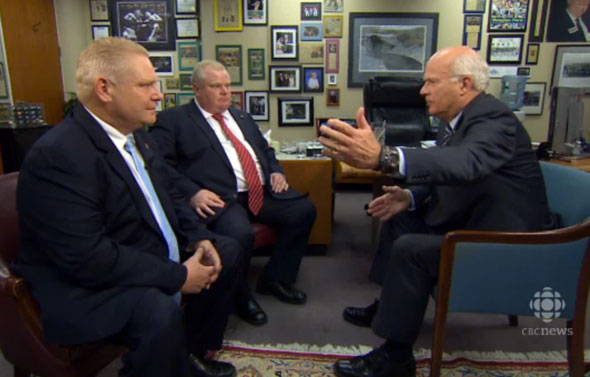
Yes people, this is our mayor (L) and his brother (R).
383,501 people have some explaining to do.

¹  Toronto Star: James: Mayor Ford Whiffs, Swinging for Subway Fences
² The Torontoist: Debating The Future of The TTC Board
Picture from NOW magazine: http://www.nowtoronto.com/news/story.cfm?content=185504

Friday, 24 February, 2012

Respect for the Taxpayer from Rob Ford - NOT!

Rob Ford got his lackeys on the TTC council to fire Gary Webster, the Chief General Manager the other day for doing his job well. They fired him without just cause. As a result, the City (that's you, taxpayers), will be on the hook for $560,000.00 for Gary's severance package. They could have let him stay for one more year until his retirement and it would have cost far less.

Now, we have no one at the helm of the TTC during a time when we need a very experienced and competent person there.

Rob Ford's Gravy Train amount = $560,000.00

Thursday, 9 February, 2012

Councillors Voted To Deny Rapid Transit For Their Constituents

On Feb. 8, 2012, the majority of Toronto City Council voted to reaffirm most of the Transit City LRT plans.
The vote was 25-18.
Nine councillors voted no to the plan that would bring rapid transit to their wards. The Ford transit plan would only have brought rapid transit to 4 of these 9 wards.

You can see a map of how the councillors voted at the Toronto Star page here.

You can see 5 maps of different versions of Toronto transit plans at the Globe & Mail page here.

Ford's plan has no LRT on Finch West, the Eglinton LRT line is much shorter on the West end, and his Sheppard Subway plan had no funding, so it most likely would not have been built any time soon.


The reaffirmed Transit City lines contains a segment of LRT that crosses the North end of Etobicoke on Finch, has an Eglinton West LRT line that extends to the edge of Etobicoke, and includes the possibility of an LRT line along Sheppard in Scarborough.

The Councillors who voted against rapid transit routes in their wards are:
1 - Vincent Crisanti
7 - Giorgio Mammoliti
11 - Francis Nunziata
12 - Frank Di Giorgio
17 - Cesar Palacio
34 - Denzil Minnan-Wong
35 - Michelle Bernardinetti
37 - Michael Thompson
40 - Norm Kelly

The wards, of the councillors above, which would end up with zero new rapid transit lines in their wards under Fords plan: 1, 7, 11, 12 and 40

Now, people who live in these wards, when it comes election time again, remember that your councillor voted to deny you vastly improved public transit.

Has Toronto's Mayor Become Irrelevant?

Photo of Rob Ford by Tannis Toohey
for The Toronto Star

Yesterday, Toronto City Council took over the lead on transit planning in the city and voted to reaffirm most of the LRT lines outlined in the Transit City plan. Council voted 25-18 to reaffirm what was already a binding agreement between Toronto City Council and the provincial government. Rob Ford had been trying to derail this plan over the past year and had successfully pulled the wool over the eyes of some of the new and centrist councillors - until yesterday.

After the council vote, Ford claimed that the meeting was irrelevant and that the premier would continue to support his own plan (a fully buried LRT along Eglinton, and a non-funded short subway dream on an Eastern portion of Sheppard).

The provinces response? From the CBC article:

Despite Ford's hopes, Ontario Transportation Minister Bob Chiarelli seemed to suggest the province would follow the will of council.

"Throughout the debate, the McGuinty government has maintained a clear stance — we wanted the city to come to a common position so that we all could focus on building much-needed transit infrastructure," he said in a statement. "Now that council has endorsed a position, we have asked Metrolinx to consider the impacts on current transit planning and report back to us as quickly as possible."

Is this the beginning of a change in the Mushy Middle? Will we see the centrists on council begin to vote for reason and their constituents instead of with the mayor? If so, then, over the next 3 years, Rob Ford may find himself outvoted and irrelevant through his own pig-headed uncompromising actions thus far.

UPDATE
Here is the list of how each councillor voted:
LRT For Toronto: Rob Ford Loses Bid To Control Toronto's Transit Future 

Two surprise votes in support of reaffirming the LRT lines were usual Ford supporters John Parker and Jaye Robinson.
Out of the ten Scarborough councillors, 1 was absent, 3 voted in support of the LRT lines, and the rest stuck with Ford and voted against the motion. 

See also
Openfile: After Yesterday's LRT Vote, Toronto Enters the Age of Minority Government
The mayor, having already lost one of the most important votes of his term so far, seems unwilling to face the arithmetic of Toronto's politics (he needs 22 votes on council, plus his own) and instead is working hard to alienate the very centre-right councillors he needs. In hushed tones, some council staff tell reporters they've never seen a mayor so unwilling to compromise. In particular, ruling out TTC Chair Karen Stintz' attempt at compromise (which everyone from Giorgio Mammoliti (Ward 7, York West) to Cherise Burda of the Pembina Institute seemed to be able to live with) left a number of staff shaking their heads.

Monday, 6 February, 2012

Toronto Councillors To Vote For the Return of Most of Transit City

TTC Chair Karen Stintz Moves To Bury Rob Ford's Subway

This Wednesday, Toronto city council will vote to bring back most of the Transit City plan. 24 members of council have called the meeting to force this vote - a vote that should have happened a year ago, and a vote that has to be held by law to rule on the fate of Transit City - a vote that Ford has been trying to avoid. Ford's plan to mislead council and to try to ignore the Transit City plan, and to just have his own way by dismantling the Transit City plan and imposing his own misguided plan - breaks the law. City council is finally taking the reigns away from Ford and is saying enough is enough.

TTC chair Karen Stintz plans to present a petition to the city clerk on Monday morning asking for a special council meeting on Wednesday. The petition is signed by 24 councillors, which constitutes a majority which in turn requires the clerk to schedule a meeting. Under city bylaws that meeting must be held within 48 hours.

Councillors at the special meeting will be asked to confirm a 2009 memorandum of agreement (MOA) for a light rail plan forged during former mayor David Miller’s administration. It is signed by the city, TTC and Metrolinx and runs out March 31. 

That agreement calls for LRTs on Eglinton, Sheppard East and Finch West, [the Transit City plan] and effectively scuttles Ford’s vision of tunnelling the Eglinton-Scarborough Crosstown LRT east of Laird Dr. to Kennedy station.


This is the vote that should have happened a year ago when Ford unilaterally and illegally declared Transit City dead. Just after Ford was elected mayor, many were predicting that council would not go along with Ford's nonsense ideas - that they would keep him in check. For his first year, this did not happen; his bad ideas were generally supported. This vote on Wednesday could be the turning point that most Torontonians have been waiting for. What the opposition on council lacked was leadership. What we are beginning to see is the collective will of the majority of council beginning to strengthen against the destructive drive of the mayor. The tide is finally turning against the bully mayor and his gangster politics. Toronto may be able to breathe a sigh of relief - and we will get our dream of a better and expanded transit system (the one that was already in place before Ford tried to derail it).

Friday, 20 January, 2012

Rob Ford Continues To Waste Your Money Hiding His Crime

http://www.thestar.com/news/article/1118538--mayor-rob-ford-s-lawyer-calls-audit-order-a-waste-of-money?bn=1
Rob Ford's lawyer, in yet another desperate plea "to prevent an audit of his [Rob Ford's] campaign expenses" ... "told a judge the forensic audit would be “a waste of taxpayer’s money”.

If Rob Ford was innocent, he would cooperate with the investigation instead of doing everything he could to stall and block the investigation (which would save taxpayers a lot of money). 

This is something that could result in him being removed from the mayor's office if he is found guilty.

Tuesday, 17 January, 2012

Toronto Prevails Over Ford Nation in Budget Vote

Liveblog: City Council's Final Debate on the 2012 Budget

The people of Toronto can breathe a sigh of relief (for now). For the most part, the majority of Toronto City Council voted against the mayor Rob Ford's plan to gut city services.

Centrist rookie councilor Josh Colle moved to reverse most of Ford's planned service cuts. Council voted 23-21 in favour of the motion.

Other motions to save city services also passed:
- To save the libraries from an additional $3.9 million in cuts - passed 22-21
- to give Toronto Community Housing the $ they saved in property taxes rather than shunting it to overall surplus - passed 33-11

Still not safe yet: 3 dozen TTC routes will have their service reduced.

I must commend the centrist councilors who finally showed some backbone tonight.

Outside, the protest got a little heated and there were a few arrests as the crowd decided to try to enter City Hall:
Live: Protest Outside City Hall Budget Talks

See also:
http://torontoist.com/2012/01/city-council-reverses-many-key-ford-cuts-passes-budget-the-mayor-never-wanted/

http://www.thestar.com/news/article/1117267--james-ford-loses-the-gamble?bn=1#.TxZIS6vqIqd.facebook

Details from Now Magazine:

Cuts reversed Tuesday include: 

  • Restore $2.3-million in funding to community grants, including HIV prevention and programs geared towards seniors, youth, and immigrant women in priority neighbourhoods
  • Avoid the closure of the Downsview Dells, Birchmount, and Bellwoods shelters
  • Maintain crowding standards and wait times on TTC routes slated for reduction
  • Preserve current service levels at libraries, including hours, programs, and material collections
  • Continue free recreation programming for youth and seniors at priority centres
  • Avoid the elimination of the Women’s Immigrant Health Centre
  • Maintain school based childcare rent subsidy
  • Avoid closure of three city-run childcare centres
  • Keep ice-rinks open during off-peak hours
  • Maintain programs at shared-use pools in TDSB schools
  • Reject $2 user fee for drop-in swims at pools
  • Provide funding to keep three staff positions at the Toronto Environment Office
  • Allow the Toronto Community Housing Corporation to keep $6 million in tax savings
  • Maintaining mechanical leaf collection

Friday, 13 January, 2012

Same Sex Marriages For Foreigners Living In Canada Nullified?

You have probably all read, by now, the news stories from Jan 12th about how the Harper government has come out saying that marriages no longer count between gay couples who have come from countries where gay marriage is illegal.
This is not actually true.

What's true is that there is a current court case where a gay couple who do not live in Canada, came to Canada, got married and then left Canada, then came back to get a divorce. Now, since they did not reside in Canada after getting the marriage, the marriage is not recognized to be valid by Canadian law. This is no change in how the law has been for a very long time in Canada.
See:
https://www.facebook.com/notes/kevin-kindred/why-nobody-gets-it-and-everyone-is-an-idiot-a-series-of-indeterminate-length/10150462308551080

However, what is getting people upset, and justifiably so, is that, 
A) we know full well that the Harper government would love nothing better than for this law to be misinterpreted in the courts to mean that foreign gay couples who have continued to reside in Canada after being married here are no longer legally married.
and
B) Harper did absolutely nothing to reassure Canadians that gay couples living in Canada, who came to get married here and have stayed living in Canada, are still legally married and that what is happening in the court case right now will not affect them. He just said he was not aware of the court case.

A supporter of equal rights and gay marriage would have reassured Canadians regarding this issue in the courts. We know that Harper, his government, and his core supporters are vehemently against gay marriage and would do anything they could to set equality back in Canada.

Olivia Chow on gay marriage

Thursday, 12 January, 2012

Sorry World

Sorry World
A site apologizing to the world for having let Stephen Harper become Prime Minister


Tuesday, 3 January, 2012

Toronto City Budget - The Problem Is Ford

Numbers Game | Toronto Media Co-op
The City budget is not and has never been in a financial crisis according to figures released by the Wellesley Institute, an urban health research and policy institute in Toronto.
...
Ford, along with the rest of the administration's allies have often repeated the $774 million deficit number as the current shortfall that has to be covered in order to balance the city budget. The perceived 'high number', along with proposed major cuts to key services such as childcare, nutrition programs and libraries, have scared a number of residents and prompted a backlash. This has allowed the Ford administration to promote a wider range of smaller cuts with less backlash.
...
The irony of the $774 million shortfall number is that it has been exacerbated by the Ford's decisions to freeze property taxes in 2011 and eliminate the vehicle registration tax. If property tax increases were maintained at the GTA average (3% a year) and if the vehicle tax was not eliminated, no cuts would be necessary.
...

“So we haven’t overspent for the last seven years, I guess,” Doug Ford said at budget deputations to Robert Cerjanec, a university student union representative. “Do you have any solutions to help the problem?”  It was a question asked repeatedly by Ford-allied councillors.
Surprisingly, neither Cerjanec, nor most of the 300+ deputants referred to the Mayor's own Core Service Review consultation.
The consultation, which polled over 13,000 Torontonians in depth-on their budget priorities, found that participants overwhelmingly supported increasing "property taxes to keep the same level of City services." 
Not increasing "user fees or taxes even if this means reducing the level of service" had the least support. The mean recommended "property tax increase for all participants was 5.15%."

The big question that Ford Nation supporters and trolls frequently ask is "do you want your taxes to increase to pay for these services?". As you can see by the above survey of 13,000 Torontonians, the overwhelming answer is YES.

Monday, 2 January, 2012

CBC - The Armageddon Factor

video
News clip by the CBC regarding the growing influence of the religious Right with the Conservative Harper government, and interview with Marci McDonald, author of The Armageddon Factor.

See also:
CBC: MPs under the influence of evangelicals?

Tuesday, 20 December, 2011

Harper Government Cuts to transfer payments to provinces should surprise no one

Canada News: Ottawa to scale back health transfer payments - thestar.com
This has been Harper's plan all along - cut federal money spent on healthcare and social services. The premiers should not be surprised that the federal government is going to reduce the transfer payments.
Of course Harper's looters in suits will continue to waste Canadians' money on more corporate tax cuts and buying non-functioning fighter jets and building un-needed superjails.

Tuesday, 13 December, 2011

Rob Ford: Coward of the Year

2011 Villain: Rob Ford | NoIndex | Torontoist

Rob Ford campaigned on lies, and blatant lies at that. A tough man in his position would fess up and admit he was mistaken about Toronto’s finances (or, alternatively, admit that he purposefully deceived the Toronto electorate so he could become mayor, and the question of which of the two of these scenarios is more accurate relies on your belief as to whether Rob Ford is more greatly motivated by malice or stupidity), but Rob Ford isn’t doing that.
Rob Ford is not a tough man. Rob Ford is a coward. The sooner we all recognize that, the better off we will all be.

Wednesday, 7 December, 2011

Rob & Doug wasting Toronto Money - Again

Toronto agency backed by Mayor Ford spent $55,000 on single-source contracts - The Globe and Mail

Asked if there was a discrepancy between his anti-sole-source rhetoric and his backing of sole-source waterfront proposals, he said “it all depends” before referring all further questions to Michael Kraljevic, president and CEO of Toronto Port Lands.
“There are circumstances when sole-sourcing is acceptable,”
How much would it have cost for Rob and Doug to run their plan by council to see if they would support it before going ahead and spending $55,000?

Rob Ford's Gravy Train amount: $55,000

Saturday, 3 December, 2011

Rob Ford = Fundamentally Undemocratic

Toronto mayor feuds with Canada's biggest daily
Conter likened Ford's war against the media to Prime Minister Stephen Harper's tight limits on media access during the recent election race, during which he only allowed five questions from reporters at each daily news conference during campaigning.
"With the five questions, it isn't just vetting questions, it is limiting access to the prime minister," said Conter. "So it is effectively blocking access to a whole bunch of people."
The concept, said Conter, seems to have inspired Ford in his war against the Toronto Star.
But it goes against the democratic duty of public officials, he added.
"Public officials in a democratic country have the duty, if not to answer all the questions of every reporter, at least to disseminate amongst all media press briefings, announcements, all that sort of thing," said Conter. "To cherry pick who you send your releases to is fundamentally undemocratic."

And, from the Huffington Post:
The recent revelation is that Rob Ford is holding the Toronto Star hostage by refusing to speak to it and provide it with news releases. The paper claims his staff are actively attempting to keep it in the dark on media stories provided to all other outlets covering Toronto City Hall, highlighting a dangerous abuse of power threatening to erode fundamental societal foundations. (Ford has since denied freezing out the Star.)
 ...
What's next for Toronto? Why don't we just close down all press and open an official propaganda office so that Mayor Ford won't have to worry about who writes what about what he is doing with other people's money in a city he shares with millions? The Chinese do it. North Korea seems to be OK at it. Soviet Russia must have left notes behind on how to run a propaganda office.

Thursday, 1 December, 2011

Rob Ford's Budget Con Job - "a giant scam being perpetrated on the citizens of Toronto."

The Grid TO | Budget 2012: Rob Ford's sleight of hand

If Rob Ford hadn’t cut or cancelled all those taxes, we’d have enough to cover the entire budget hole without eliminating a single bus route, library hour or arts grant, without laying off a single staff member, and without drawing on reserves.

Just to repeat so it’s perfectly straightforward: Dollar-for-dollar, every single cut in the 2012 operating budget was made necessary by Rob Ford’s 2011 tax cuts. Period.

An unnamed “top official in Rob Ford’s office” told Robyn Doolittle of the Toronto Star that this was the plan from the beginning. In November 2010, he said that because of the tax cuts, the “safety net” would be gone: “Councillors will be forced to approve whatever we put forward.”

There are many Torontonians who think the city overspends on staff salaries, grants to community groups, bike lanes, transit and all kinds of other things. That’s fine. An honest politician could make that case, and cut those services deemed unnecessary or unwanted. And then, with the savings, that honest politician could either redirect the money to more necessary programs or cut taxes. Plenty of people would disagree loudly with those decisions, but at least the process would be prudent and truthful.

Instead, Ford cut revenue first so that a “crisis” would force us to cut services even if we thought they were necessary or desirable. It’s as if you looked at your household budget, decided that your spouse’s decision to buy organic vegetables rather than regular ones was making it a challenge to get ahead, and then quit your job as the first step to solving that spending problem. You could try to blame your sudden inability to pay the mortgage on your spouse’s gourmet-food habit, but it would remain obvious that your decision to eliminate income was the real cause of the crisis.

That’s what Rob Ford has done here. He calls it “respect for taxpayers,” but it looks more like a giant scam being perpetrated on the citizens of Toronto.

Tuesday, 29 November, 2011

Toronto G20 Protests - Police Officers Were Given Orders to Make Illegal Arrests

Toronto News: Man settles G20 lawsuit, claims police brass ordered false arrests - thestar.com

Officers detaining Wall on June 27, 2010, told OPIRD investigators they were instructed to arrest people wearing bandanas, masks or gas masks concealing their identity. One officer said he was told to search anyone with a backpack, and if that person refused, he or she could be arrested for obstructing police.

Davin Charney, Wall’s lawyer, said the report shows the many unlawful arrests of that weekend were not just the result of a few bad apples or overreaction from front-line officers. “The orders must have come from the top.”

Sunday, 16 October, 2011

More gangster politics/backroom dealing from Ford Nation

NOW Magazine // Daily // News // Mammoliti slams door on councillors
Giorgio Mammoliti, acting on behalf of the mayor, barred councillors Kristyn Wong-Tam and Janet Davis from the recent Child Task Force meeting. The meeting was supposed to be an open meeting. Wong-Tam just wanted to observe, and with good reason - she sits on the Community Development Committee, which delivers childcare.

Ford, during the campaign, said he would put an end to what he called "sweetheart backroom deals". But, since being elected, he has turned around 180 degrees on this issue. Ford's been keeping the majority of council in the dark on many things, and now this.

Ford appointed Mammoliti to the child care task force back in July.
Its goal is to investigate alternative funding models for the child care
spaces the city subsidizes, and many observers believe Mammoliti will
recommend privatization. Wong-Tam and Davis would strongly oppose that
move.

“Whether or not they agree with my politics or I agree with
their politics is not the point,” Wong-Tam said. “The point is we have
to respect our democratic civil institutions and the tools that give us
good government.”


Toronto mayor Ford still confused after provincial election. Better chance now for Transit City comeback

NOW Magazine // Daily // News // Transit City’s minority report
Excerpts:

The results of the provincial election have encouraged progressives
still holding out hope for the resurrection of Transit City. 

Councillor
Adam Vaughan is among the devotees waiting for the transit plan’s
second coming, and lately he’s seeing good omens. One of them is that
the mayor’s replacement for Transit City has stalled, for the time being
at least. The province agreed to fund part of it (the underground LRT
along Eglinton), but so far Ford has been unable to secure enough
private funds for an extension of the Sheppard Avenue subway. 

Another
encouraging sign for Vaughan is the results of last week’s provincial
election, which saw the pro-Transit City NDP gain more power in a
minority government, and confirmed that “Ford Nation” no longer has the
ear of the province. The political playing field is looking rather
different than when Dalton McGuinty acquiesced to a newly-elected and
still popular Ford on Transit City.  

“You’ve got a group of
councillors who support Transit City, and you’ve got a significant group
of provincial legislators from the GTA who want light rapid transit,”
says Vaughan. “Meanwhile you’ve got a mayor who’s still dreaming in
Technicolor when it comes to Sheppard avenue. The mayor’s just one voice
in a sea of people with a lot more power than him.” 

On the
transit file, Ford is looking increasingly desperate. The morning after
the provincial election, the first thing he did was venture out of his
cocoon of protective right-wing media for an interview on the liberal
CBC in which he publicly aired his demand for more provincial funding
for Toronto transit. 

A spokesperson for transportation minister Kathleen Wynne says the
province has no plans to give the city more transit money at this time,
but if that changes, NDP transit critic Cheri DiNovo says any provincial
funding should come with strings attached. 

“If the province is
going to be paying huge amounts for more transit, the province should
have a say in what it’s used for,” DiNovo says. “And Transit City is the
best way of spending it. I’m sure Ford would rather see something built
than nothing built. If we’re paying the piper we get to call the tune.”

...

There remains one development that could alter the political
equation. When Ford decided to cancel Transit City, he made Toronto
liable for the costs associated with work already underway. 

That
bill from the province is expected to be upwards of $49 million, but
mercifully for Ford, who is in the middle of a crusade to stop waste at
city hall, it has yet to arrive. Once it does, Transit City may start
looking a lot more attractive, says Vaughan. 

“There is no
$49-million bill to repay if Transit City gets back on track,” he said.
“For a city and a province looking to save money, the easiest way to
save money is to stop canceling things and to start building things.”


Friday, 7 October, 2011

Aid blackmail in Palestine

Aid blackmail in Palestine - Opinion - Al Jazeera English
Excerpt:
Once again, Palestinians are being punished for daring to exercise a choice.

It happened before in 2006, when they took part in what was deemed to be the wrong kind of democracy and picked the wrong (Hamas) government. That mistaken execution of free will caused the international community to close its funding tap - cutting Palestinian aid and salaries.

Now, there are penalties for taking another 'wrong' turn, despite repeated threats and warnings: US congress is blocking US $200 million intended for the Palestinian Authority (PA), which persisted with its UN statehood bid in the face of US disapproval.

Few things typify international complicity in stalling Palestinian aspirations like this on/off money switch. The current cut in cash will affect health and social projects - but not, it is said, the PA's security commitments (coordinated with Israel). In other words, the pinch is designed to cause Palestinian suffering - but is calibrated so as not to upset Israeli concerns, or totally derail the stagnating status quo. ...

Top 10 under-reported facts about a decade of war in Afghanistan

Top 10 under-reported facts about a decade of war in Afghanistan | rabble.ca
Excerpt regarding "Women's Rights"
The "women's rights" rationale has been exposed as a cynical sham. I'm not sure who really takes this fraud seriously anymore, but it's important to remember that this was presented early on through wall-to-wall media coverage as a key reason for occupying Afghanistan. Afghan women's rights boosted the careers of many western NGO spokespeople, but from the beginning the post-Taliban government installed by NATO was full of anti-women fundamentalists. Rapists continue to enjoy widespread impunity in Afghanistan; female suicide by self-immolation is higher than ever. Many outspoken women's activists have been murdered, either by the Taliban or by fundamentalists linked with the Afghan government. Others, like Malalai Joya, have been banished from elected positions.

Analysis of ON 2011 Election Results vs My Prediction

My prediction vs the election results.

Party - Prediction - Election
Lib - 50 - 53
PC - 31 - 37
NDP - 26 - 17

I was pretty close with my Liberal prediction, but off in my PC and NDP predictions significantly.

NDP prediction
I put too much credence in the trend of the NDP continuing to rise. It seems that the debate may have given the NDP a rise in some specific ridings, but not across Ontario in general. As a result, there were a number of ridings where the NDP came in a close 2nd that I thought they would win. Probably the biggest recipient of any last minute boost to the NDP came in Bramalea-Gore-Malton, where Jagmeet Singh won for the NDP. I don't think this area has ever elected an NDP member to parliament.

PC prediction
There were a few upsets that weren't predicted in the polls where the PC upset a Liberal incumbent (where it was deemed a safe seat for the Liberals). And, there some close PC-Liberal races where the Liberals had the slight edge in the polls, but the PCs gained even more support on election day.

I figured we would get a Liberal minority government and we did. A step in the right direction - a baby step.

Am I happy with the result. Of course I would have preferred an NDP government, but at least now, there will be some instances where the NDP may be able to bring some pressure on the Liberal government to implement some measures they would like to see.

Unfortunately, we will still see our money squandered on more useless corporate tax cuts (since the PCs and Liberals both want these). This will make it more difficult to reach a balance budget while providing services and support to Ontarians.

Wednesday, 5 October, 2011

Ontario Election Predictions Oct 2011

My predictions
(based on riding projections from 308.com, recent polls, polling trends, individual riding polls)
Liberals 50 seats (minority government)
PC 31 seats
NDP 26 seats

threehundredeight's predictions
LIberals 57 seats (majority government)
PC 30 seats
NDP 20 seats


Tight races the NDP are in:
Northern Ontario
Saulte Ste Marie - Liberal/NDP
Sudbury - NDP/Liberal

Eastern Ontario
Kingston & the Islands - Liberal/NDP

SW Ontario
Essex - Liberal/NDP
Sarnia-Lambton - PC/NDP
Windsor West - NDP/Liberal
Windsor-Tecumseth - Liberal/NDP

Toronto
Scarborough-Guildwood - Liberal/NDP/PC
Toronto Centre - Liberal/NDP
York West - Liberal/NDP


Reasons to vote NDP in Ontario on Oct. 6, 2011

Here is what the NDP will do for the people of Ontario:

Economy, Taxation, Jobs
Rolling back corporate tax cuts.
History has shown that lowering corporate taxes does nothing to create jobs. In fact, often, what happens is the corporation uses the new money they have gained from the tax cut to line their pockets with money, give their CEOs huge raises, close local plants and set up shop in other countries where the cost of labour is lower. Over the past years of corporate tax cuts under the PC and Liberal governments, business investment in Ontario has actually dropped. Corporate tax cuts don't work! The Liberals and PCs plan to cut the corporate tax rates even further (from 11.5% down to 10%), costing the province another $2 billion per year. We can't afford this and it won't help anyone except the corporations. The NDP plan to roll back the rate to 14%, which is still lower than in most other North American regions. The revenue for the province from this will go a long way to pay for  services for the people of Ontario, help offset costs that the Mike Harris PC government downloaded to cities (thus helping municipal budgets), and to reduce the Ontario budget deficit.

Economic Stimulus/Job Creation
"New Democrats would deliver the most stimulus and job creation at the lowest fiscal cost by focusing on measures with the biggest bang per buck: direct public investment and targeted tax credits. By contrast, Liberals and Conservatives have prioritized slashing tax rates on corporate profits, the least effective way to stimulate the economy." (see
http://www.progressive-economics.ca/2011/10/05/ontario-platform-stimulus/
for details)

The NDP will give tax credits to businesses that actually invest in their business in Ontario and to businesses that actually create jobs.

The NDP will lower small business taxes.

The NDP will buy Ontario products when comparable (within 10%) to the lowest bid for products for Ontario (this will help create jobs and put more money in the Ontario economy), and, they will work towards improving industry here (like processing our own lumber instead of shipping raw lumber to the USA - selling processed lumber will result in more money and more jobs in Ontario.)

Deficit/Budget
The NDP budget has been fully costed and independently verified. Their budget costs LESS than the plans of the other big parties, has a larger contingency fund (in case of difficult economic times), and doesn't waste $2 billion/year on corporate tax cuts. All the parties plan to balance their budget within the same time span, but the NDP plan is the most realistic and is actually the most fiscally conservative of all the budget plans.

Stop spending $1 million/day on consultants

Cap government CEO salaries.

Transportation, Municipalities
The NDP will return the provincial funding of public transit to municipalities -  50% of the operating cost of public transit to municipalities (which is much more than anything fare hikes would net) if the municipalities promise not to hike fares. This will a) go a long way to help municipal budgets, b) improve public transit, and c) help people better afford public transit.

Healthcare
Change the way healthcare services are prioritized in order to improve services to people and to reduce costs. Also, cap healthcare CEO's salaries (which are already close to $1 million!)

Reduce emergency room wait times.

Give seniors the support they need to live in their homes.

End ambulance fees.

Education/Students/Tuition
Ontario has the highest tuition fees in Canada. Since the Liberals have been the governing party in 2003, tuitions have gone up 30%. The Liberals plan on allowing SOME students a 30% rebate, but allow tuition to continue to increase. The Liberals promised to lower tuition fees in 2003 and 2007 down to the Canadian average, but didn't. The NDP plan to freeze tuitions at current rates as well as eliminate the provincial portion of the interest on student loans. (Differences here will be made up out of provincial funds, not on the backs of students or the institutions.)

Ban course fees in high schools

Reduce school reliance on parent fees and fundraising (by improving school funding)


Power, Environment
Freeze Transit fare for 4 years to encourage more public transit use (and less car use).

Return to funding 50% of the operation cost of public transit for municipalities so they can better afford to maintain and improve these services.

Offer up to $5,000 in home energy retrofit rebates

Phase out coal-fired electricity

Invest in cycling infrastructure

Make sure that polluters bear the costs of clean-up, not municipalities.

Invest in green energy.

Promote energy conservation.


Making life more affordable, Housing
The NDP will remove the HST from home heating and hydro, remove the HST from fuel, freeze transit fares and tuitions. They will also work on stopping price gouging at the gas stations.

Increase the minimum wage to $11/hour.

Bring in a new housing benefit to help low-income Ontarians better afford their rent

Build 50,000 new affordable housing units over 10 years

Create a new dental care program for low-income Ontarians


Rural Ontario
When the government purchases produce, they will look to buy Ontario produce first.

Increase shelf space for independently-produced Ontario wines at the LCBO

Encourage on-farm processing by relaxing municipal taxation and zoning

Establish a Rural School Stabilization Strategy

Forgive tuition fee debt for medical students who work in rural areas


Respect for Northern Ontario
Make it the law that resources that can be processed in Ontario won’t be shipped away

Take the HST off of electricity and home heating and start to take it off gasoline

More doctors for under-serviced communities and new family health care centres

Ensuring First Nations benefit from resource development and are empowered to play a full role in improving their communities


You can find more details at
http://ontariondp.com/en/policy

Isn't it time you voted for a party that is looking out for you, the people of Ontario, instead of the wealthy corporations? On Oct. 6th, you can - vote NDP for a better Ontario.

Tuesday, 4 October, 2011

NDP Finance Critic Peggy Nash's motion passes unanimously

NDP finance critic hails symbolic economic victory over Tories - The Globe and Mail
It's rare, and non-binding, but it's a positive step. The motion calls for "the government to act immediately to create jobs and keep Canada out of a recession."

Excerpt:


Ms. Nash, a Toronto MP and architect of the motion, said she was surprised at the result of the vote.


“It’s a positive step,” she told The Globe Tuesday. “Our motion really
laid out the points we have been raising since the last election in
terms of infrastructure investment, tax incentives for new hires, tax
reduction for small business.”


It also called on the government to move away from what Ms. Nash
describes as its “illogical and unnecessary across the board corporate
tax cuts.”


To be clear, a motion is not a law and is in no way binding on the
government. But Ms. Nash is encouraged nonetheless, arguing that
accepting a motion in good faith indicates “intention.”


She is now hopeful the Conservatives will follow up with action. Indeed,
since the return of the House from its summer break two weeks ago, the
NDP has been hammering the government over economic issues, demanding it
detail how it intends to create jobs and abandon its plan to give
corporations tax cuts.


The vast majority of questions New Democrats have asked in Question
Period have related to the economy. And the NDP’s first opposition day
motion, which was tabled last Thursday and went to a vote Monday night,
was a laundry list of demands about how to fix the economy.


“Who says you can’t get things done in a majority government,” Ms. Nash
said, adding quickly: “Well we are waiting for action, actually.”


She may be waiting for awhile, however. So far, she has heard only
speculation about what the government might do – some small
infrastructure stimulus, some help to small business.


It is very doubtful, however, the government will go as far as
abandoning the corporate tax cuts. “I don’t know when the dust settles
what they are actually introducing, if anything,” she said.

Harper and Flaherty did not vote.

A message of support from Olivia Chow for Andrea Horwath

A message of support from Olivia Chow for Andrea Horwath - YouTube
NDP momentum is spreading. Don't let them tell you it can't be done. Put people first, vote NDP!


A message of support from Olivia Chow for Andrea Horwath

Thursday, 29 September, 2011

ON Election Fact Check: NDP spending least, PC spending most

In this new article, Tim Hudak claims that the NDP is a "big spending" party. Let's look at the facts.

Both the PCs and Liberals have committed to spending almost $2 billion dollars on another wave of corporate tax cuts. But the PCs go further by committing to a total of $5.565 billion in tax cuts.

The total cost of the PC platform is $5.995 billion - this is mainly tax cuts to corporations and wealthy, and many service cuts (and they're not saying what they will cut).
Meanwhile, the total cost of the NDP platform is only $3.352 billion - no corporate tax cuts - mainly contingency funds, discounts, and boosts for services that most people could use, and tax cuts only for businesses that actually create jobs.
   See: Fiscal Cost of Ontario Platforms here.


So, Hudak is very misleading to say the least as his party is the biggest spender and remains faithful to the term Looters In Suits - taking our money and giving it all away to the rich.

See the full costing of the NDP platform here.


Andrea Horwath the real winner of the debate

Horwath Wins Ontario Debate: MSM Miss the Boat | rabble.ca
Ethan Cox writes about what the MSM missed - that there was a large improvement of opinion regarding Andrea Horwath's performance in the debate by those who were interviewed before and after.
There appeared to be little change in opinion regarding the other 2 party leaders. But, 14% said they changed their mind about who they were going to vote for. This has the possibility to help push the NDP support over the 30% mark, at the same time lowering the support for the other parties, and putting the NDP neck and neck with the Liberals and PCs.
 
Excerpt from Ethan's post:
But that's only the beginning of the story. The second most compelling stat in the report (I'm coming to the first, don't worry), was the stunning number of Ontarians whose impression of Horwath improved. Let's go to the report again:

it was Andrea Horwath who made the biggest impression on Ontarians as 67% say they have an improved impression of her as a result of the debate, while just 10% say their impressions worsened, representing a net score of +57, effectively making her the real winner of the debate. By comparison, Jack Layton’s net improvement score in the English-language federal debate was +41 points, and +42 in the French-language debate. Three in ten (29%) have an improved impression of Dalton McGuinty, compared to a similar proportion (31%) who have a worsened impression, representing a net score of -2. Four in ten (37%) say that their impressions of Tim Hudak improved, while one in three (34%) say they worsened, a net score of +3.[emphasis mine]

Now that is a pretty stunning number, but Liberal and Conservative spin doctors would no doubt argue that people's impression of Horwath may have gone up, but that doesn't necessarily mean they'll vote for her. After all, someone who hated her before might have had their impression softened, but still prefer another candidate.

So let's look at the most important piece of information in the poll, as far as I'm concerned. Back to the report we go:

With the NDP leader performing so well compared to expectations, it is interesting to note that one in ten (14%) viewers say they changed their mind about who they were going to vote for as a result of what they saw tonight, with the NDP appearing to be the biggest beneficiary among those who viewed the debates and reportedly switched their vote.

Horwath was also chosen as the leader with the best ideas and policies (35% +10), the most likeable leader (52% +8) and the most "visually attractive" (54% +12). On the issues, Horwath came out on top with viewers as the candidate they most trust on Healthcare (35%, +11) and came second on Taxes (24% +5) and Education (29%, +10).

So in summary, Horwath was the runaway winner of the debate, improving the opinion of 57% of viewers, and 14% of viewers will shift their vote as a result. So could one of the numerous pundits opining that no one won the debate, and that no one succeeded in moving voters, explain their position to me please?


Even taking into account margin of error and the fact that not all Ontarians watched the debate (although they'll certainly hear about it around the proverbial water-cooler) we're talking about a minimum of 5-8% shift from the other parties to the NDP. Transpose that onto the most recent poll results and you're looking at the NDP above 30% and in a three way dead heat with the Libs and Cons.

In other words, ladies and gentlemen, I think we have a ball game. So I wonder if journalists didn't bother to read the Ipsos report through, inexplicably failed to notice the huge shift to Horwath which the report writers underline on several occasions, or chose to run with the story that the debate was a wash because it fit better with their own narrative of the campaign?

In any case, barring the remote possibility that Ipsos produced a rogue poll, I expect to see a significant swing to the NDP in the polls over the next week. This will leave us with a thrilling three way race to the finish, in which Horwath has as much chance of snatching the Premier's chair as either of her opponents.

The NDP are back in Ontario, and that, coincidentally, is very good news for their federal cousins. It's going to be one hell of a finish. I'm certainly looking forward to it.